Census Data
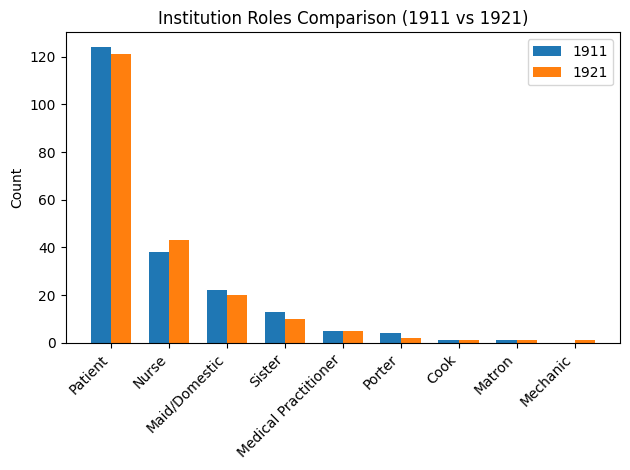
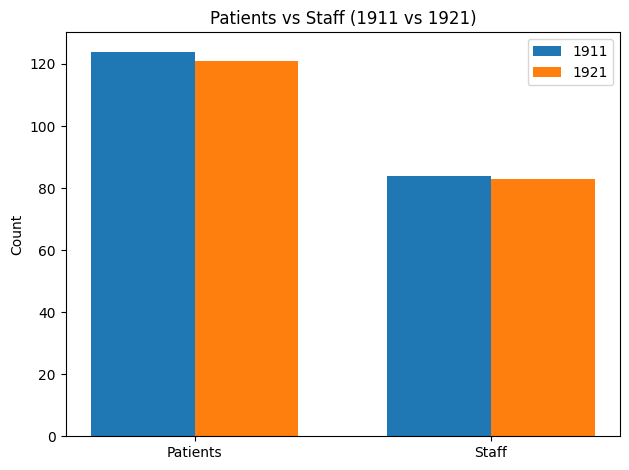
Between 1911 and 1921 the overall size of the institution remained largely stable, declining only slightly from 208 to 204 individuals. The number of patients decreased marginally from 124 to 121, while total staff numbers remained almost unchanged (84 in 1911 compared with 83 in 1921), indicating a broadly consistent patient-to-staff ratio across the decade. However, changes occurred within the composition of the workforce. The number of nurses increased from 38 to 43, suggesting a shift towards a more medically focused model of care. In contrast, domestic and supervisory roles declined slightly, with maids falling from 22 to 20 and sisters from 13 to 10. Porters also decreased from four to two. Medical practitioners, matrons, and cooks remained constant, while a new role—mechanic—appeared in 1921, possibly reflecting the increasing technological infrastructure of institutional settings. Overall, differences in the data indicates a modest professionalisation of staff, with greater emphasis on nursing and reduced reliance on domestic labour.
View transcription of the census return for 1911.
View transcription of the census return for 1921.
1911 Census - Positions
| Year | Position | Count |
|---|---|---|
| 1911 | Patient | 124 |
| 1911 | Nurse | 38 |
| 1911 | Maid | 22 |
| 1911 | Sister | 13 |
| 1911 | Medical Practitioner | 5 |
| 1911 | Porter | 4 |
| 1911 | Cook | 1 |
| 1911 | Matron | 1 |
| TOTAL | 208 |
1921 Census - Positions
| Year | Position | Count |
|---|---|---|
| 1921 | Patient | 121 |
| 1921 | Nurse | 43 |
| 1921 | Maid/Domestic Servant | 20 |
| 1921 | Sister | 10 |
| 1921 | Medical Practitioner | 5 |
| 1921 | Porter | 2 |
| 1921 | Cook | 1 |
| 1921 | Matron | 1 |
| 1921 | Mechanic | 1 |
| TOTAL | 204 |